Project Overview
A leading beverage manufacturer in Thailand—operating a high-volume PET bottle packaging facility serving ASEAN markets—faced urgent regulatory pressure to upgrade its 12-year-old primary packaging line. The legacy system, originally designed for throughput rather than hygiene, failed to meet evolving ISO 22000:2018 and U.S. FDA 21 CFR Part 110 requirements. With annual output exceeding 1.2 billion units and strict export compliance mandates from Singapore and Malaysia, the client engaged our industrial automation team to execute a phased, production-minimized retrofit—preserving core machinery while transforming hygiene-critical zones.
Challenge Analysis
The existing line featured stainless-steel frames but incorporated non-sanitary components: open-belt conveyors with inaccessible crevices, pneumatic actuators with exposed lubrication points, and robotic end-effectors lacking IP69K-rated washdown capability. Microbial swab tests revealed Listeria monocytogenes contamination in conveyor transfer zones, triggering internal audit non-conformities and delaying a key contract renewal with a regional supermarket chain. Additional challenges included minimal downtime allowance (<48 hours per line segment), legacy PLCs incompatible with modern hygienic control protocols, and workforce unfamiliarity with sanitary maintenance procedures.
Solution
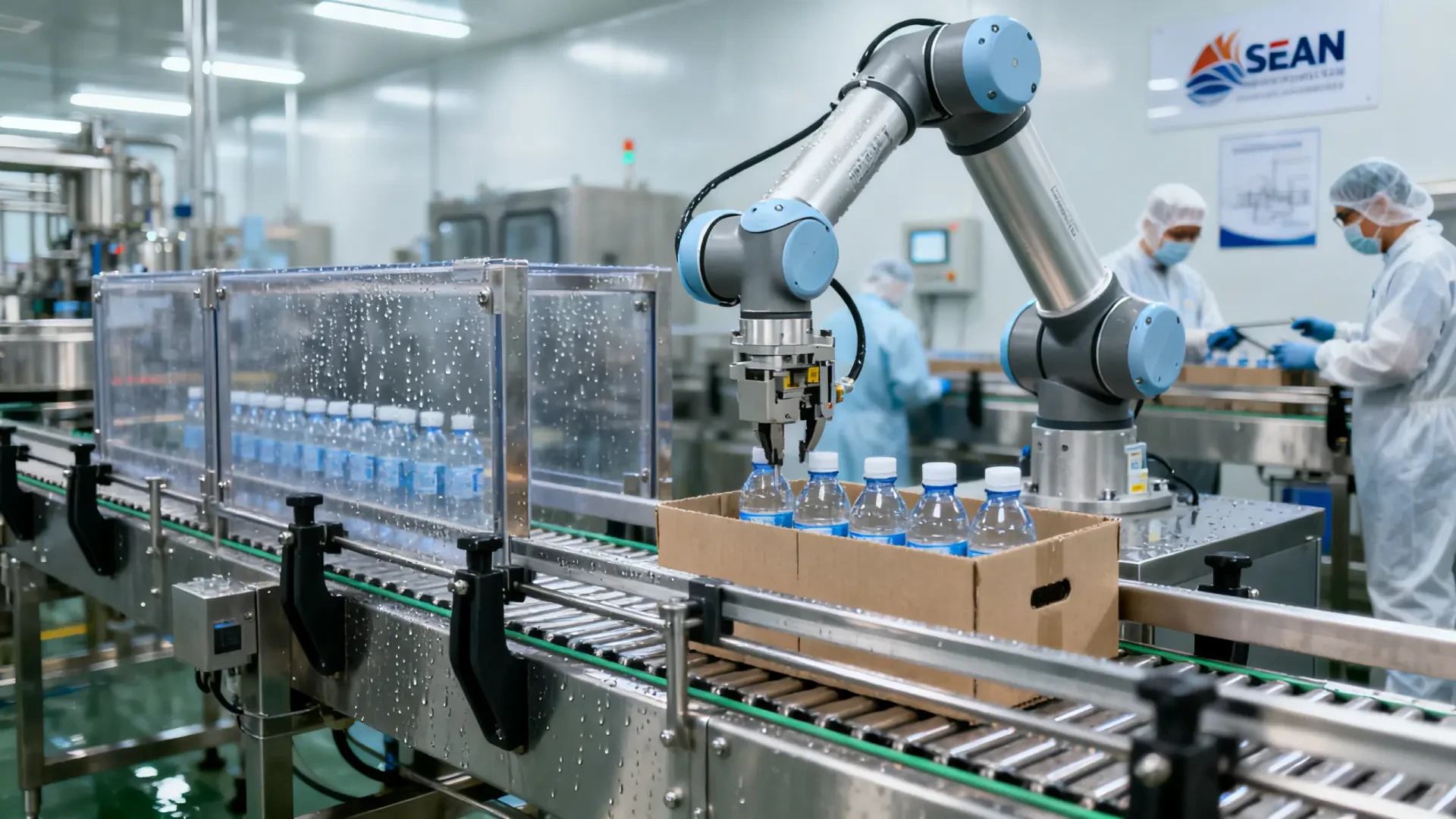
We delivered a modular, risk-mitigated retrofit centered on food packaging automation and hygienic conveyor systems. Key interventions included: replacing all horizontal and incline conveyors with FDA-compliant, fully enclosed stainless-steel modular belts featuring quick-release tensioning and zero-tool disassembly; integrating IP69K-rated collaborative robots (cobots) with silicone-gripper tooling for case-packing stations; installing CIP-ready stainless-steel guarding with seamless welds and 3R radii corners; and upgrading the control architecture to a hygienic-certified PLC platform supporting real-time sanitation logging and HACCP parameter tracking. All new components met EHEDG Type EL Class I standards and were validated for sanitary robotics integration. Crucially, the retrofit was engineered as plug-and-play modules—each installed during scheduled weekend shutdowns without requiring full line stoppage.
Implementation Process
The 14-week project followed a three-phase rollout: Phase 1 focused on upstream filling-to-capping transition zones (completed in 3 weekends); Phase 2 addressed secondary packaging—including palletizing cells and stretch-wrapping stations—with custom-designed washdown enclosures (5 weekends); and Phase 3 covered validation, staff training, and documentation handover—including full FAT/SAT reports, material traceability dossiers, and SOPs aligned with line retrofit food industry best practices. Our engineering team co-located onsite for 6 weeks, collaborating with plant maintenance leads to ensure knowledge transfer and long-term operational sustainability.
Project Results
Post-retrofit validation confirmed 100% compliance with ISO 22000:2018 Clause 7.2 (Prerequisite Programs) and FDA 21 CFR Part 110 Subpart B (Plant and Grounds). Microbial testing showed >4-log reduction in surface bioburden across critical zones. Downtime for sanitation decreased by 62%, and changeover time between product formats improved by 38%. The client achieved FDA registration renewal within 30 days and secured two new export contracts—totaling USD $4.7M annually. Energy consumption dropped 11% due to optimized servo-driven conveyance, and OEE increased from 72% to 89% over six months of sustained operation.
Client Feedback
“This wasn’t just an equipment refresh—it was a hygiene culture transformation. The modular approach let us maintain production while future-proofing our line. Their expertise in food packaging automation and deep understanding of ASEAN regulatory expectations made all the difference.” — Senior Operations Director, Thai Beverage Group