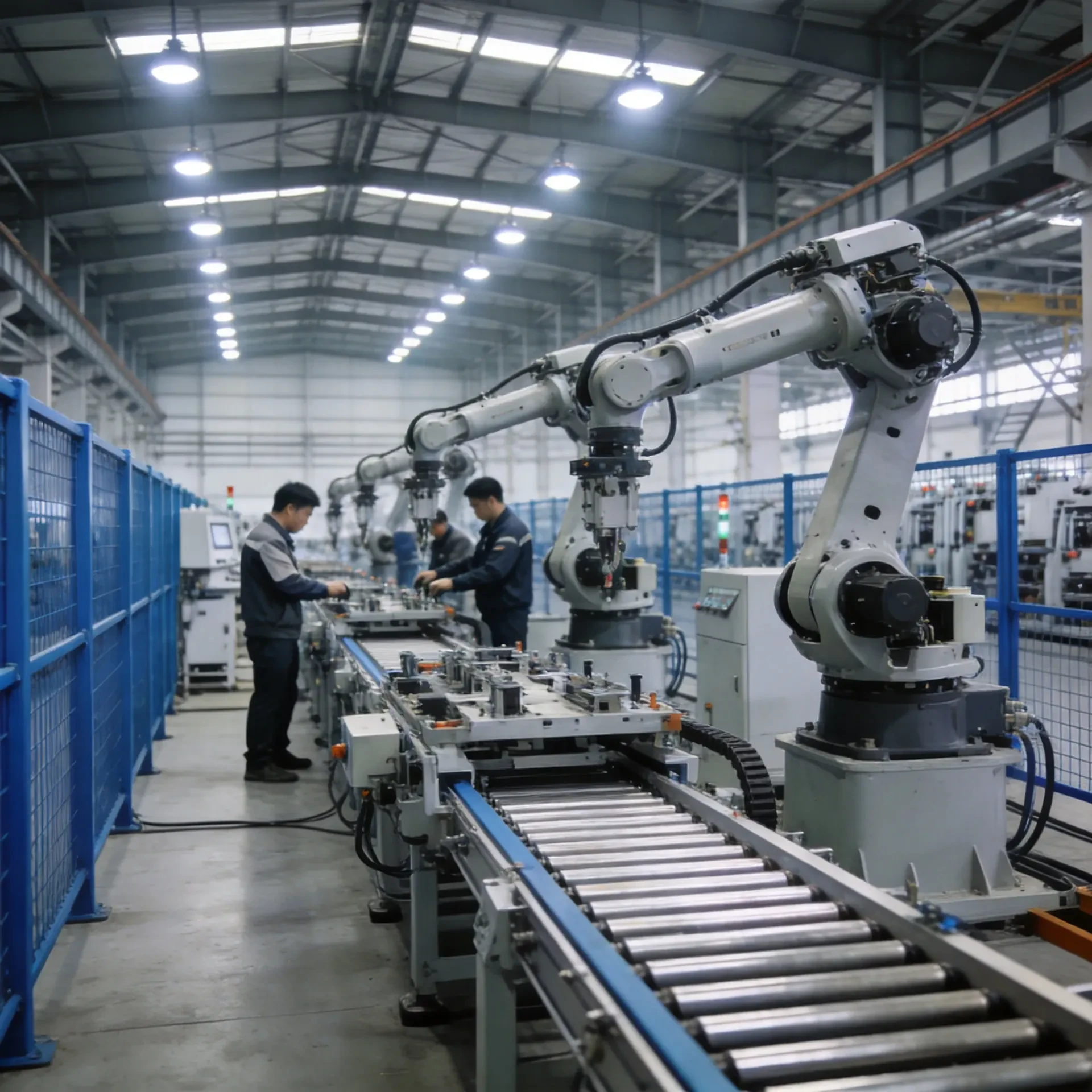

Project Overview
A leading European biopharmaceutical manufacturer specializing in sterile injectables engaged our engineering team to modernize its aseptic filling suite. The project involved designing and integrating a fully automated Class A/B cleanroom filling line for monoclonal antibody (mAb) vials — handling high-value, low-volume batches under strict GMP Annex 1 requirements. With production volumes of up to 400,000 vials per month and stringent sterility assurance demands, the client required zero manual intervention during filling, capping, and inspection phases. Our solution delivered end-to-end pharma automation compliant with ISO 14644-1 Class 5 (ISO Class 5) environments and EU GMP standards.
Challenge Analysis
The client faced three critical operational challenges: First, human-dependent manual interventions introduced microbiological risk and variability in fill volume accuracy (<±1.5% tolerance required). Second, legacy equipment lacked real-time process monitoring and traceability — hindering audit readiness for FDA and EMA inspections. Third, traditional robotic systems failed to adapt to vial size variations (2–20 mL glass and polymer vials) and inconsistent cap torque specifications across product lines. Additionally, the cleanroom layout imposed spatial constraints, requiring compact, modular integration without compromising airflow laminarity or personnel access paths.
Solution
We engineered a turnkey vision-guided dispensing system centered on a dual-station isolator-integrated platform. At its core was a high-precision servo-driven peristaltic pump with closed-loop pressure feedback, delivering ±0.8% volumetric accuracy across all vial sizes. Integrated into the line were two collaborative robots (cobots) equipped with 5-megapixel industrial vision systems calibrated for sub-pixel vial centering and cap presence detection. Each robot performed synchronized tasks: one handled vial orientation and positioning via vacuum grippers; the other executed torque-controlled capping with real-time force sensing and adaptive algorithm adjustment. All motion control, vision processing, and data logging were unified under a validated SCADA platform compliant with 21 CFR Part 11. Critical components — including robotic arms, dispensing nozzles, and conveyor modules — were constructed from electropolished 316L stainless steel and certified for VHP (vaporized hydrogen peroxide) compatibility. The entire system underwent full IQ/OQ/PQ validation support, including media fill simulation and environmental monitoring integration.
Implementation Process
Deployment occurred in three validated phases over 14 weeks: Phase 1 involved cleanroom retrofitting and isolator interface commissioning; Phase 2 covered robotic calibration, vision system training using 12 vial/cap variants, and GMP-compliant software configuration; Phase 3 included integrated dry-run testing, media fill trials (≥10,000 units), and final regulatory documentation handover. Our engineers worked under gowning protocols inside the Class B background environment, coordinating closely with the client’s QA and validation teams to ensure alignment with their internal SOPs and change control procedures.
Project Results
The integrated system achieved immediate and measurable impact: fill accuracy improved from ±2.1% to ±0.7%, reducing product rejection by 92%; cycle time decreased by 34% (from 12.8 s/vial to 8.4 s/vial); and operator touchpoints dropped from 17 to zero during the filling-capping-inspection sequence. Full electronic batch records (EBR) are now generated automatically, cutting post-production documentation time by 75%. Most significantly, the line passed its first EMA pre-approval inspection with zero critical observations — validating its GMP compliant automation architecture. Annual OEE increased from 68% to 89%, supporting the client’s expansion into biosimilar injectables.
Client Feedback
‘This vision-guided robotics integration transformed our sterile manufacturing paradigm,’ stated the client’s Head of Technical Operations. ‘It wasn’t just about speed — it was about predictability, compliance, and scalability. The system’s adaptability across vial formats and its seamless audit trail generation have become foundational to our quality-by-design strategy.’