Introduction
Selecting the optimal conveyor system is a pivotal decision that directly impacts throughput, labor efficiency, product integrity, and long-term operational cost. With diverse configurations—from belt-driven units to overhead monorails—choosing the wrong type can lead to bottlenecks, excessive downtime, or costly retrofits. This guide provides a practical, step-by-step framework for industrial engineers and plant managers evaluating material handling equipment for new or upgraded production lines. We examine five critical dimensions: load characteristics, required line speed, environmental conditions (e.g., washdown, temperature, dust), integration needs with upstream/downstream automation, and total cost of ownership—including ROI timelines. Grounded in real-world deployment data across food processing, automotive assembly, and electronics manufacturing, this industrial conveyor guide helps you align technical capability with strategic production goals.
Understanding Load Requirements
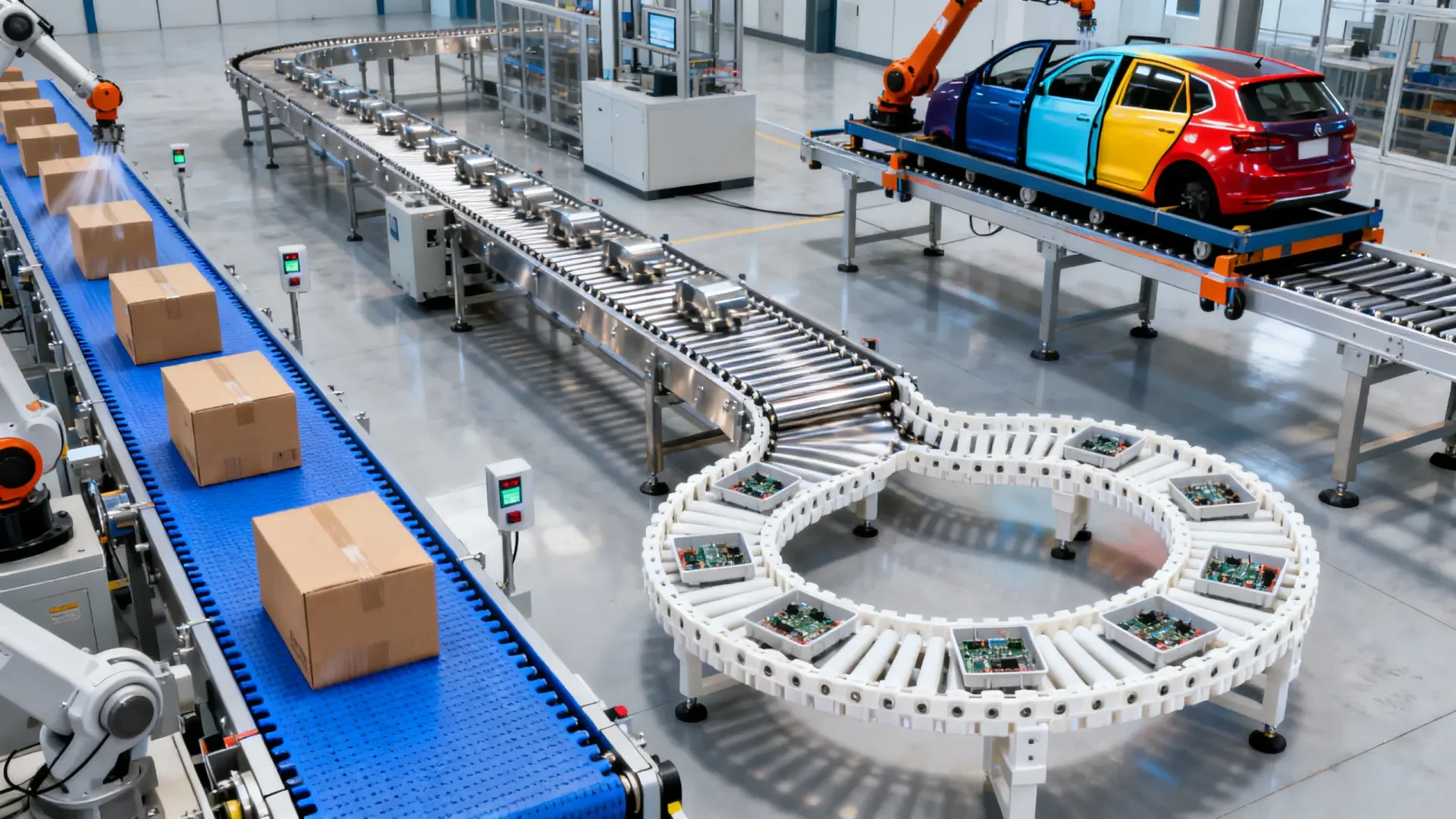
The physical properties of your conveyed items dictate fundamental design constraints. Bulk materials like granules or powders demand troughed belts with sidewalls; rigid cartons require stable, low-slip surfaces; while fragile electronics or glass components need gentle accumulation zones and precise indexing. Weight distribution, orientation consistency, and dimensional variability further influence roller spacing, belt tension, and drive sizing. Ignoring load dynamics often results in jamming, misalignment, or premature wear—especially when transitioning between packaging, inspection, and palletizing stations.
Speed, Throughput, and Control Precision
Conveyor speed must match cycle times of adjacent processes—not just peak theoretical output. A high-speed belt may cause product slippage if upstream filling stations operate intermittently. Conversely, overly conservative speeds reduce line capacity and inflate labor-per-unit costs. Variable-frequency drives (VFDs) and servo-controlled modular conveyors enable zone-specific speed tuning and synchronized start/stop logic—critical for lean manufacturing and just-in-time workflows. For high-mix, low-volume lines, programmable logic controllers (PLCs) integrated with vision-guided diverters allow dynamic routing without mechanical reconfiguration.
Environmental and Operational Constraints
Harsh environments impose non-negotiable specifications: stainless-steel frames and FDA-compliant belts for washdown areas; explosion-proof motors in solvent-rich paint booths; or heat-resistant rollers near kilns and ovens. Dust ingress can cripple bearings in roller conveyors, while humidity degrades belt adhesion and sensor accuracy. Modular plastic chain conveyors excel in wet or corrosive settings due to their self-lubricating, non-metallic construction. Overhead conveyors bypass floor-space limitations and contamination risks entirely—ideal for cleanrooms or congested assembly halls where footprint optimization is paramount.
Integration Readiness and Scalability
Modern production lines rely on seamless interoperability. Conveyor systems must support standard communication protocols (EtherNet/IP, PROFINET, Modbus TCP) to exchange status, fault codes, and position data with MES and SCADA platforms. Quick-connect electrical interfaces, standardized mounting brackets, and modular frame extensions simplify future expansions or line reconfigurations. Retrofitting legacy lines demands attention to mechanical interface tolerances—e.g., matching conveyor height to robotic arm end-effector reach or AGV loading docks. Prioritize vendors offering validated integration kits and OEM-certified PLC libraries.
Conveyor Selection Decision Matrix
To streamline evaluation, compare core conveyor types across four operational pillars:
| Selection Criterion | Belt Conveyor | Roller Conveyor | Modular Plastic Chain | Overhead Conveyor |
|---|---|---|---|---|
| Typical Load Capacity | Light to medium (up to 50 kg/m) | Medium to heavy (up to 100 kg/unit) | Light to medium (up to 30 kg/unit) | Light to medium (up to 40 kg/unit) |
| Flexibility & Layout Options | Limited curves; straight/incline only | Fixed radius curves; limited incline | High—tight curves, vertical lifts, multi-plane routing | Very high—3D pathing, ceiling-mounted, no floor footprint |
| Maintenance Frequency | Moderate (belt tracking, tensioning) | High (bearing lubrication, debris clearance) | Low (no lubrication, self-cleaning design) | Moderate (trolley wheel inspection, chain tension) |
| Initial & Lifecycle Cost | Low initial; moderate TCO | Low–medium initial; higher TCO (labor-intensive upkeep) | Medium initial; lowest TCO over 5+ years | High initial; competitive TCO in space-constrained facilities |
Conclusion
Selecting the right conveyor system transcends component specification—it’s a strategic alignment of material flow physics, automation architecture, and operational economics. Begin with load profiling and environmental mapping, then validate integration pathways before finalizing layout schematics. Avoid over-engineering for hypothetical future loads; instead, prioritize modularity and protocol openness to ensure adaptability. When applied rigorously, this conveyor system selection framework reduces commissioning time by up to 35% and improves mean time between failures (MTBF) by 40% across industrial applications. Partner with suppliers who offer application engineering support—not just catalog sales—to translate your production line conveyor requirements into reliable, scalable reality.